· by Katie Matski · 5 min read
Both in-home and clinic euthanasia are legitimate choices, and the right one depends on your family, your pet, and your circumstances. Clinic care is more affordable and widely available. In-home care costs more and offers something the clinic cannot: your pet never leaves the place where they feel safe, and you are never separated from them. Rover Veterinary Care is transparent about both options and helps Reno families choose based on what actually fits their situation. Call or message Rover Veterinary Care at (775) 800-6463 to talk through which approach makes sense for you.
What a clinic visit looks like
For families in the Sparks area near Reno, a clinic appointment is often the most accessible option on short notice. You call, you get an appointment, you load your pet into the car. Most pets tolerate car rides and vet offices reasonably well under normal circumstances. Under these circumstances, many do not. A dog who is already weak and uncomfortable may experience real distress in the car, in the waiting room, and in the exam room, all before the procedure begins. Some clinics bring families in through a side entrance and move quickly to reduce that stress. Others do not have that capacity.
Once in the exam room, a clinic visit typically involves the pet being taken to the back for IV catheter placement before being returned to the family. That separation, even brief, is something families often describe as unexpectedly hard. The room itself is clinical. The appointment is time-limited. The veterinarian has other patients. There is nothing wrong with this. It is efficient, professional care. Families who have experienced a clinic visit and are now considering an in-home option for a subsequent pet often describe wanting something different, not because the clinic did anything wrong, but because the setting did not match the moment. Midtown Reno veterinary clinics, like those elsewhere in the city, are doing their jobs well within the constraints of a clinical environment.
The Old Southwest neighborhood of Reno, where many longtime residents and older pets live, illustrates a common scenario: a large senior dog who cannot comfortably manage the car ride, whose anxiety spikes in unfamiliar spaces, and whose family wants to be holding him on his own bed when the moment comes. For that family, the clinic visit would require managing their grief and managing the dog's distress simultaneously, in a space that belongs to neither of them.
What an in-home visit looks like
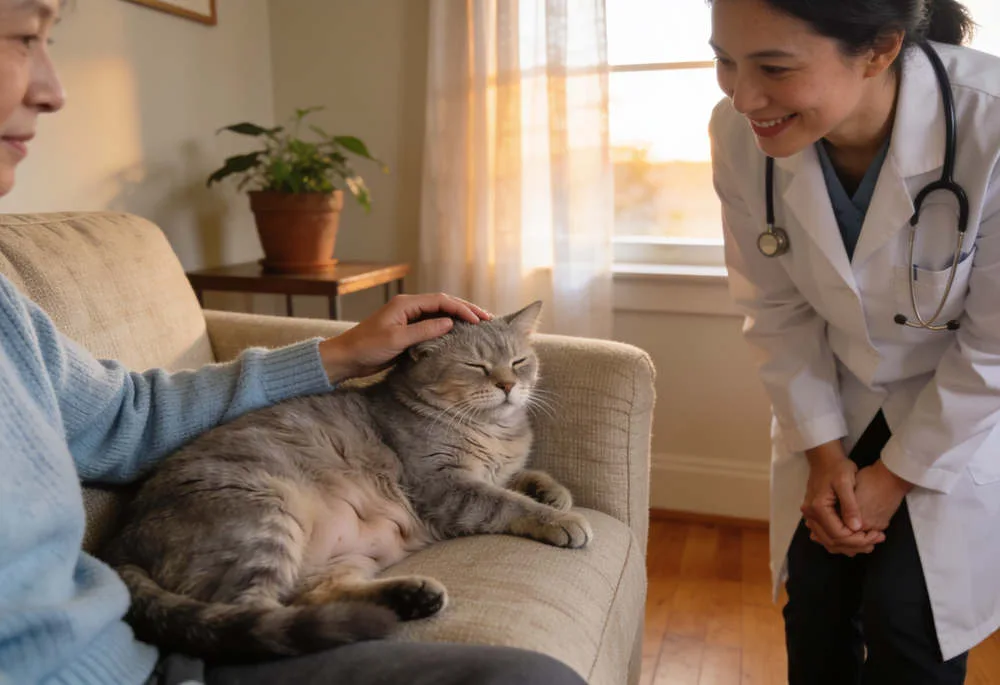
Dr. Katie texts an estimated arrival time before she comes. She arrives in an unmarked vehicle and lets your family settle before anything begins. You choose where to be: the living room, the back yard, the bedroom where your pet sleeps. There is no intake process at the door and no waiting room. She reads the room and follows your lead.
The pet euthanasia procedure has two steps. The first is a sedative injection, similar to a vaccine, that takes five to ten minutes to bring your pet into a deep, pain-free sleep. You can hold them throughout this time. When they are fully settled, the second injection is gentle and nearly instant. You are present for both. Dr. Katie confirms with a stethoscope, then steps back and gives your family private time.
Before she leaves, she makes a clay pawprint keepsake for any family who wants one. She can also collect a small amount of fur. Neither is rushed. The full visit runs thirty to forty-five minutes, and the pace is set by your family, not by a schedule.
The honest difference in cost
In-home care costs more than a clinic visit. That is straightforward and worth saying plainly. The difference reflects the vet's travel time and the unhurried structure of the visit, not a premium on emotion. A clinic can see multiple patients in the time an in-home visit takes. That efficiency is what makes clinic care more affordable, and it is a legitimate reason to choose it.
Rover is a small, family-run practice rather than a large corporate service. That keeps costs more reasonable than some in-home providers in the Reno market, and it means Dr. Katie handles cases herself rather than sending staff on her behalf. The care is personal because the practice is personal.
Cremation options in Reno
For families who want pet cremation, Rover offers three options: individual, communal, and private. Individual and communal cremation are the lower-cost choices; private cremation guarantees that only your pet is cremated in that cycle and that the ashes returned are theirs alone. Dr. Katie handles transport personally when cremation is chosen through Rover, so you do not coordinate a second service on the same day.
If you want to ask questions about either option before you decide anything, that call carries no obligation. Call Rover Veterinary Care at (775) 800-6463 or send a message to Rover Veterinary Care and someone will help you figure out what fits.